Rude Yard by Question Beggar
Sensing the time was right for another concept album, in the early winter of 2023—and backed by a fortunate meeting—I pushed ahead on this, the album that became “Rude Yard.” The concept was to make my own version of a Jethro Tull album, a tribute, really. Instead of using my own lyrics, however, (a career first) I picked several poems by Rudyard Kipling and wrote some Tullish tunes for them.
I call it "Rude Yard" as a play off of "Rudyard." I’m quite pleased with the results. Although hardly representative of the complexity and genius of Ian Anderson’s work, there’s certainly a bit of the flute combo savagery, primitively rendered. Neander-Tull, if you will.
I’ve carried the idea of putting out a Rudyard Kipling album since Fall of ’86, when I discovered a collection of his poems in my father’s bookshelf. “A Smuggler’s Song” caught my attention and as I read it, I could hear the Aqualungish form of a tune accompanying the words, though I didn’t write it down. “Harp Song of the Dane Women” also got me composing, and that one I did write down and record, but re-wrote the lyrics to be about Rock N Roll widows instead of Viking wives. And that’s about as far that project went.
Fast forward slowly to Fall of 2022, where I would attend monthly meetings of the local musicians of Arlington, Arlington Nights. On Sunday afternoons we get together and introduce ourselves, hear local music, and drink beers. One particular Sunday in September, a fellow named Steve Cosio got up and introduced himself, mentioning that not only was he a flute player, but he was known to play standing on one leg. The Jethro Tull dog whistle was unmistakable. I made a point to go up and speak with him, but he escaped the event before I could do so. October 12th, I tracked him down on Facebook, messaged him and put my scheme together.
Around about this same time a snatch of classic Kipling floated into my consciousness from a Mark Steyn piece I’d read years before, quoting the poem, “Tommy.” (“…It’s Tommy this and Tommy that and chuck ‘im out, the brute/ but it’s savior of ‘is country when the guns begin to shoot…”) It occurred to me that I’d never read the whole poem, so I looked it up on the Kipling Foundation site. Again, a tune came to me, just reading it. Then I started trawling the list of poem titles and several others jumped out at me, including a reunion with “Harp Song” and “Smuggler’s.” I decided on the bones and guts of the project soon after and wrote the six tunes over about two days. This was late October, 2022. By the end of October, I had demos recorded for each song and sent them along to Steve to learn, figuring we’d record them in my studio, some time in December.
Someday I’ll release those demos. They’re pretty good, excepting the drum machine tracks. Nothing wrong there, per se, I just prefer live drums. I put the drum tracks on the demos because I was also considering having a drummer play, too. Just a snare and hi-hat kind of thing. When the drummer I had in mind turned out to be a bit flakey, I cut my plan back to just me and the flautist. I would come to be glad I did, yet also regret it…
From mid-January to the end of April—6 sessions total, 1 song each time—Steve and I recorded the instrumentals. I knocked the vocals out the next week and then mixed and remixed the songs from May to June. I can honestly say this was the toughest album I’ve mixed ever. Since “Guest” anyway. Part of the problem was due to half of the songs being recorded live, with Steve and I playing together. I put all my attention to performing and not nearly enough to capturing the drum and guitar tracks. Halfway through the recording I finally saw the light and recorded my parts first, then recorded Steve’s flute separately. It was generally quick business either way, though, with most sessions lasting about 2 hours. “Tommy” might have pushed 3 hours. It’s a long song, though.
I hadn’t worked with another artist since 2014 or so, and I’d never worked with a flute player. Steve was extremely accommodating and, much to my delight, a true player. To my recollection, I gave him like zero direction on what to play. He came in to record, on time, knew the songs, charted them out, even (!!) and seemed to have a good time playing. As a couple of Tull fanatics, we traded all kinds of talk about the band and their albums. Having met Ian Anderson twice—once in person and once by calling into a radio show—Steve was practically rock royalty to me.
Finally, in June, I had a breakthrough in the mixing when I discovered a horrible mistake that’s probably messed up my mixes since “07Q.” The amplifier that powers my studio monitors has bass and treble boosting knobs and the bass knob was boosted to about 3 o’clock. God knows how long it had been like that, skewing the playback and probably causing me to mix too little bass in the final. Once I fixed that, the mixing for “Rude Yard” progressed much better and by early July I had my finals.
As I mentioned earlier, I did come to regret slightly not having a proper drummer on hand. I’ve gotten pretty good, if I do say so myself, at the percussion I provide by tapping my foot and fingers to trigger my drum module, however, on a couple of the songs, I had the horror of perceiving that my beats seemed to be out of time slightly to the other instruments. On a couple of the songs, I wound up adding replacement drum tracks and even replacement bass tracks, to no avail. Eventually I found my way out of the sonic jungle to sanity, balancing and cutting the sounds in and out. But I’m glad I didn’t suffer having a drummer along, too. That would have quickly overwhelmed me, to say nothing of my tiny studio.
This is also a unique Question Beggar album because I mastered it. Except for “Western Man from Back East” and “Whole Other Day,” no QB album has ever been mixed. I could have mastered them all, as my trusty digital deck—the 2006 Zoom MRS-1608—has a mastering function. 17 years of recording on it, and I never bothered to even check out that feature. Whatever. That is SO me. Just, no curiosity sometimes.
“Rude Yard” is a 3-guitar album: the Grumbleduke 3 string bass, of course, and the Gold Tone 3 string bass resonator, and—making it’s major comeback on record since 2012—the 1967 Eko 3 string bass/guitar hybrid. Each instrument is featured on two songs: the Grumbleduke on “Smuggler” and “Dane,” the Gold Tone on “Tommy” and “Gods”, and the Eko on “Beggar” and “Glories.”
Thematically, “Rude Yard” is very timely. And, hopefully, timeless, thanks to old Rudy. “Smugglers (A Smuggler’s Song)” is rich in corruption and amorality as explained—and excused—to a young girl. Or could these 18th century rum runners work as a stand in for today’s human trafficking, too? Three of the songs are war songs (“Beggar,” “Tommy” and “Dane ”), but from the Homefront angle: men going to war, families left behind, ruined men having returned. I understand Kipling’s been somewhat cancelled and considered a racist warmongering xenophobic etc etc, but his humanitarian expressions of support for the innocents trampled in the wake of a rush to war alone should surely earn him tenure in western culture. Is there already a similar rush to war close to boiling over these days? “Gods” is so on-target to skewer today’s leftist idiocy it could get a guy reading the poem (“Gods of the Copybook Headings”) aloud on YouTube banned. “Glories (The Glories)” ends the album with a hopeful note of acceptance and realistic appreciation for the free will of all. I think. I really kind of need the Cliff Notes on that one.
All in all, it's an album about compartmentalism: how we split our personas to deal with hardship in order to cope. The adult in "Smuggler" instructs a child to "watch the wall" to avoid being a witness to illicit activities, to not react to everything that's going on around her. "Beggar" collects money for formerly dependable family providers who've been called to war and now—leaving behind property and kin—have been rendered "absent-minded beggars." "Tommy" features a vet who's treated schizophrenically by society—a hero marching to war and a bum after the war's over. The viking wife in "Dane" leads a double existence as a happy farm couple during winter and a lonely widow in the Spring and Summer as her man goes raiding. "Gods" sets up a duality in mankind's history, following the sensible Gods of the Copybook Headings to survival and the spendthrift Gods of the Marketplace to ruin. "Glories" collectively shrugs at the end: let's acknowledge our splits and differences.
I hope this album reaches the ears of Tull fans to be welcomed. They’ve likely been bummed, as I have, over the years at the band’s limited output. A fella gets used to a new album a year for a while and then…the late eighties…the nineties…the oughts…the tens…It’s been hard scrabble hearing new Tull for a while. Imagine my chagrin that the year I put out “Rude Yard” Tull puts out a new disc, second year in a row. Really good ones, too. Steve’s flute playing here is very much of the early, raw and ragged Tull style, and I couldn’t be happier with it.
Here’s also a hope that the work of Kipling will find further appreciation by songwriters looking for a great lyrical source. Most of his work is in the public domain now and seems tailored to be set to music. Before recording, I did a quick Google search to see if anyone else had written music to the obscure—I assumed!—poems I picked. Turns out, quite a lot of artists have. I didn’t listed to any of them. Didn’t want to be influenced or discouraged. Really, Kipling was a rockstar of his time. He would drop a new poem and it would go straight to the front pages and onto to popular notoriety.
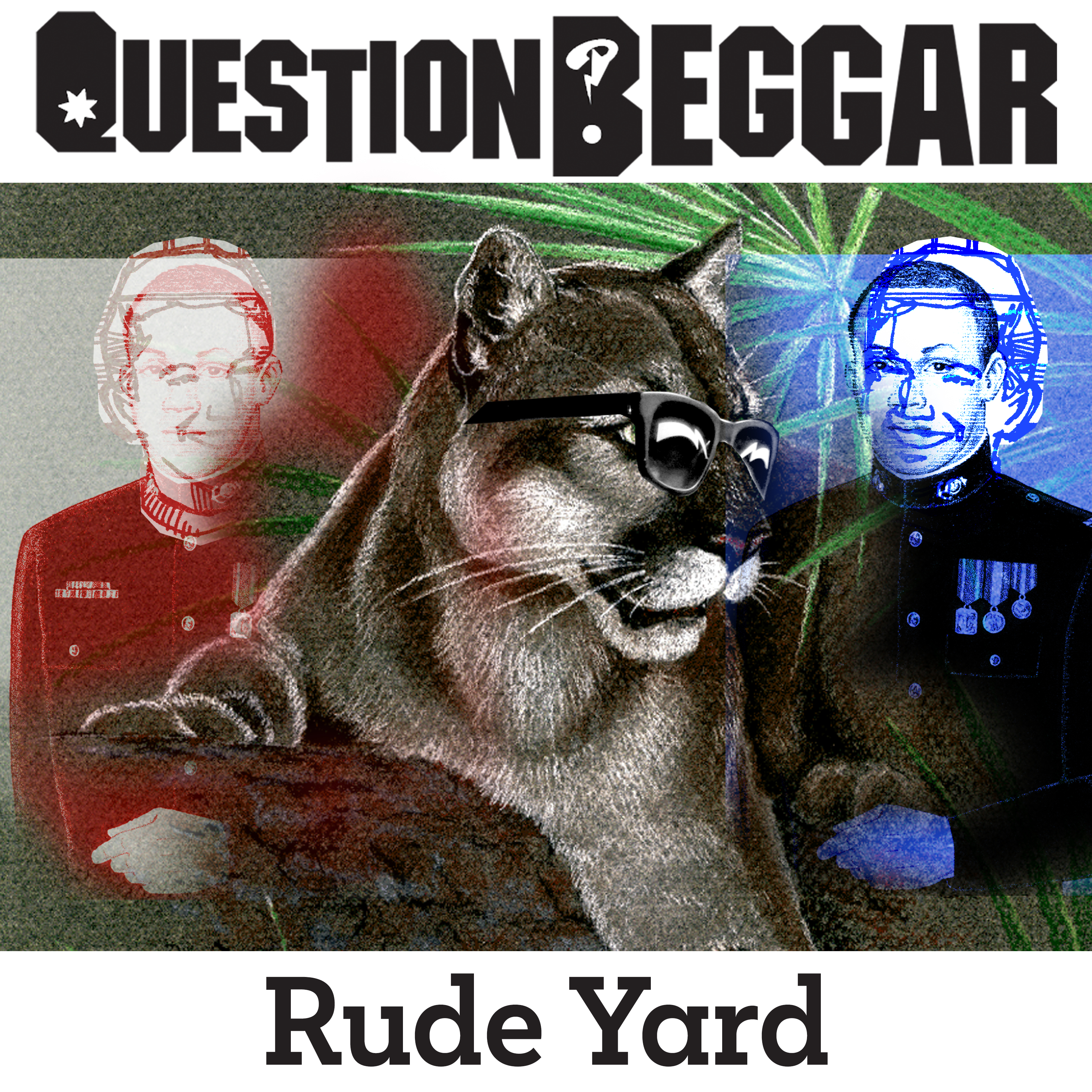
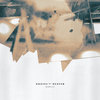
A note about the album artwork. Initially, I drew up a cartoon of Kipling’s face and added my lightning specs but…It just wasn’t working. I looked on Adobe Stock for some Kipling art, but it was lame. Oddly, pictures of jungle cats would come up. Duh. The Jungle Book, right? The Kipling face I drew wasn’t doing it for me, so I started adding clip art from the 90s and colorations in Photoshop. I had a military man, and I mirrored him, making on blue and one red, like the line from “Smuggler.” The soldiers have civilians superimposed on their faces to show the complications of home vs. war. Then I added an observant jungle cat, for old Rudyard, and my specs and called it good.
-Question Beggar
August 7, 2023
Credits
Produced, engineered, mixed and mastered by Question Beggar. Lyrics by Rudyard Kipling. Music by Question Beggar. Vocals, Bass and percussion by Question Beggar. Flute by Steve Cosio.
License
CC BY-NC-SA 3.0. See the Creative Commons website for details.


Out of the rubble of vonHummer, Claxton Kent arose, and from the ruin of Claxton Kent, Question Beggar stood erect, raised the fallen banner and continued the work of Heavy Skiffle. Still playing the 3-string bass, tapping his faithful Wave Drum with one foot, Question Beggar chunks along with dark, witty lyrics sung in coyote yelps and pleasing no one but himself, apparently.