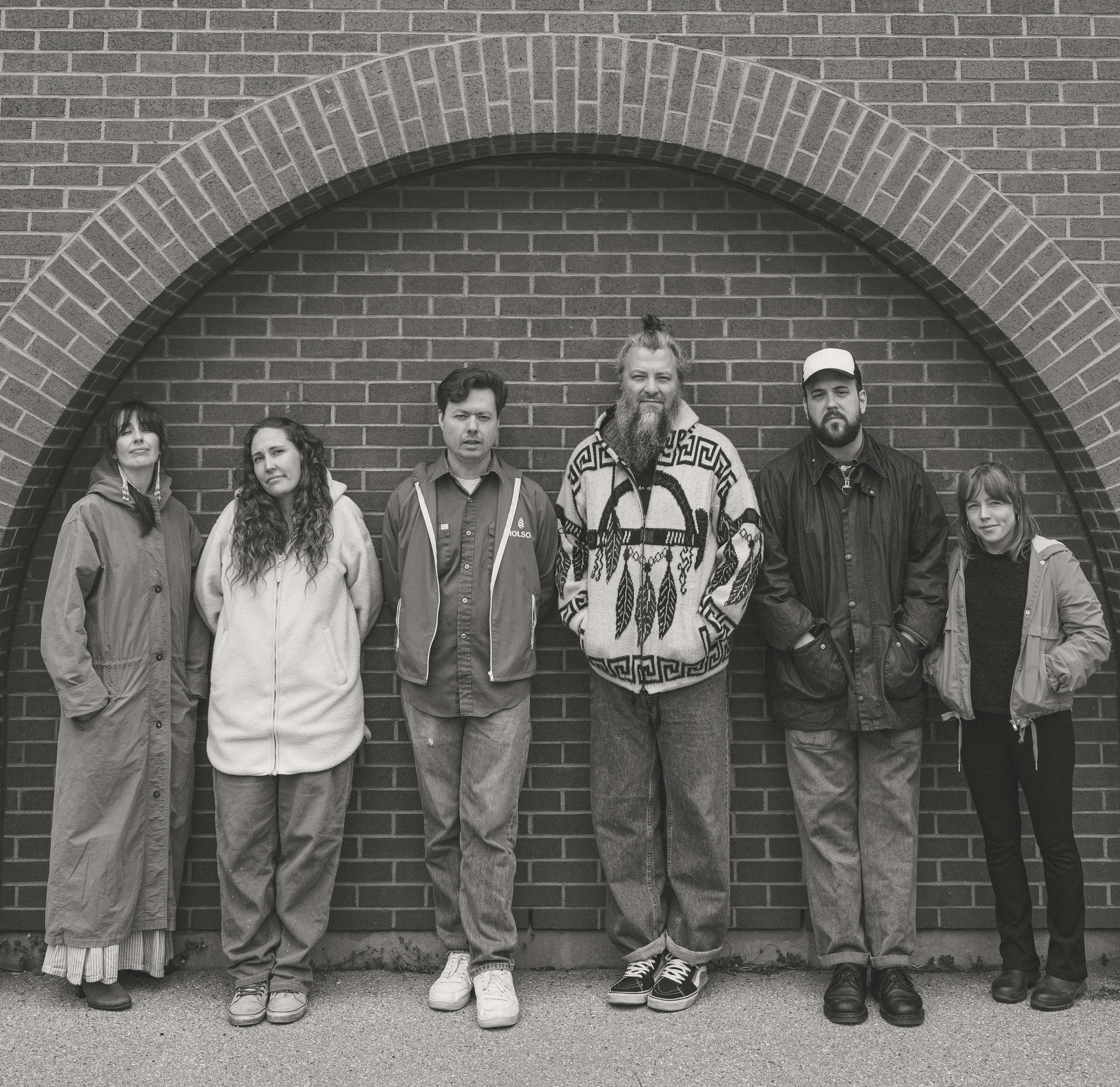
Big Changes by Status/Non-Status
Are we there yet? More specifically, are you there yet? There being the inflection point where the urge to recede into the blissful innocence of youth is in a constant tug of war with the inescapable pull of conscious adulthood. Where the joys of June and July descend into the autumnal weight of August and September. Are you at the point where you look around at the chaos and confusion swirling through our collective psyche and say, “It can’t get any worse than this,” or do you think, “This too shall pass”?
Are you ready for Big Changes? Because Adam Sturgeon is. Over the years, Anishinaabe musician and artist Sturgeon has undergone a metamorphosis, shedding old monikers and reclaiming heritage. In 2021, the collective formerly known as WHOOP-Szo became Status/Non-Status as part of Sturgeon’s ongoing exploration of the complex roots of his family history. Together with Zoon’s Daniel Monkman (who makes a guest appearance on Big Changes), Sturgeon introduced the world to OMBIIGIZI in 2022 via their Polaris shortlisted record Sewn Back Together. Regardless of which project Sturgeon is working on, though, the one thing that doesn’t change is how he treats it: like family, protecting it at all costs. Every reinvention, every reckoning, every return leads back to the same role: provider, protector, father.
Big Changes comes from living through what Sturgeon describes as “a war on people and their ways of being” while engaging in the everyday domesticity of dropping the kids off at daycare, heading into work, doing chores around the house, and figuring out how to survive “what is beginning to feel like a real apocalypse.” Inspired by his in-the-moment work with OMBIIGIZI, and with over 40 rough song ideas on hand, Sturgeon recruited Dean Nelson (Beck, Thurston Moore, Stephen Malkmus & the Jicks) and Matthew Wiewel (of Deadpan Studios and engineer of Status/Non-Status’ previous album, Surely Travel) to build a home studio in the old church he lives in with his family in London, Ontario. Everything on Big Changes “Is centralized around our Monday morning recording sessions,” he says, “and this routine of caring for my young family in a disintegrating and tough city.”
For Sturgeon, Big Changes also reflects his lifelong dialogue with duality, a dichotomy “…felt through the contrast of being a mixed person,” who sees “racism perpetuated against people more visible than myself, while also not feeling like I’m Indian enough.” The record tussles with that uneasy and impossible balance of simultaneously walking in two worlds with conflicting values. It’s less a statement of intent than a lived reflection, one that acknowledges tension without resolving it. “I don’t feel conflicted about where I stand, but I’m not sure I’m always seen,” Sturgeon says, adding that, “[on Sewn Back Together, OMBIIGIZI] found balance in the dichotomy of being damaged and using it as a tool to move forward. Big Changes, however, is foreboding and inquisitive about what is to come.”
The song “Big Changes” brings these big ideas and concepts down to street level, reflecting the daily realities of life just outside Sturgeon’s own front door. “This song is about my hood, where I live and raise my family and what I see when I walk out the door,” he says, describing a neighbourhood “mired by gaps in the system” and burdened by housing crises, addiction, and lateral violence. Caught in the crossfire between bureaucratic inaction and a community’s will to survive, “Big Changes” expresses how people are forced into change simply to keep going, whether that change leads somewhere better or somewhere harder doesn’t really matter. What matters is endurance, adaptation, and the resilience to find ways to live with what’s left.
“Bones” looks backward to understand and forward to heal. Sturgeon calls it “another dive into and through the past to see where we have come and what is still very much out of our control,” tracing how the wounds of colonialism and the weight of history continue to echo through generations. The song is like a time capsule love letter to the next generation of Indigenous youth, who have inherited the burden of truth and reconciliation from systems they never built, carrying responsibilities born of oppression they never asked for.
Though most of Big Changes took shape in Status/Non-Status’s former church-turned-home studio, the album’s thematic crux originates with a song written shortly after the release of 2019’s Polaris Music Prize long-listed album, Warrior Down. “Bitumen Eyes” is a “post-colonial rock odyssey” in two parts. “Truth and Reconciliation / is out of the land and into the pocket / of an old white man,” sings Sturgeon on the reflective first half, as the music swells to match his rising delivery. “Black snake in a locket / with its bitumen eyes that only sees profit,” he declares, confronting the commodification of sacred ground. The song’s final lines—“What of the water?”— are a lament and a demand, a reminder that for Indigenous peoples, the preservation of land and water is also the preservation of self. “Bitumen Eyes II” answers the question not with words but with its raw, explosive, and urgent off-the-cuff arrangement that, by Sturgeon’s account, “really pissed off our neighbours with how heavy we were playing.”
Despite its title, one thing that Big Changes doesn’t mess with is the music. Status/Non-Status hold fast to their intuitive and fluid style, their musicianship grounded in connection, familiarity, and an overarching trust in the power of their glorious noise. If anything, Status/Non-Status is more refined on Big Changes, summoning a sound that’s deliberate while retaining the untamed energy that first inspired them. Crunching guitars clock the daily grind of the nine-to-five on opening track “At All,” while bursts of ’90s indie-rock energy collide with sugar-coated power pop melodies on “Peace Bomb.” Ominous shades of gothic blues hang in the air on the title track, while the yin and yang of male and female harmonies (supplied by Broken Social Scene’s Kevin Drew and Rachel McLean) on “Blown Again” temper abrasion with warmth. On “Basket Weaving,” a collaboration with Odawa poet and artist Colleen “Coco” Collins, contemplative acoustics and ambient synth textures intertwine with anthemic rock flourishes in an exploration of “ancestral experience of reconnection.” The influence of Canadian noise-rock pioneers Eric’s Trip runs like an undercurrent through Big Changes, especially in its community-minded spirit. That lineage comes full circle on the delicate lullaby ballad “Good Enough,” featuring Eric’s Trip Julie Doiron. “Working with Julie Doiron, my teenage hero and favourite bass player,” says Sturgeon, “is something I could only ever dream of. I don’t take accomplishing my dreams for granted,” he adds. “I am just so lucky Julie is such a giving and wonderful community member.”
At its core, Big Changes is an act of community-building. Though its songs focus on reckoning, reflection, and resistance, the album derives its strength from the people who contributed to its creation. Alongside Sturgeon, there is a host of both long-time and new collaborators and friends—like Eric Lourenco, Jessica O’Neil, and Kirsten Kurvink Palm—as well as an extended circle of artists (including Steven Lourenco and Sunnsetter’s Andrew MacLeod) expanding Status/Non-Status into an every growing collective of artists that embodies the push and pull that animates the album itself: the tension between consistency and change and living in solitude and solidarity.
Big Changes is about survival, but also about making connections in order to endure. It is the big noise we make together when the world feels like it’s falling apart, and the harmony that comes when we keep time with one another.
Tracklist
| 1. | At All | 4:10 |
| 2. | Peace Bomb | |
| 3. | Big Changes | |
| 4. | Blown Again | |
| 5. | Basket Weaving | |
| 6. | Arnold | |
| 7. | Good Enough | |
| 8. | Bones | |
| 9. | Bitumen Eyes | |
| 10. | Bitumen Eyes II | |
| 11. | Tom Climate | |
Credits
Recorded at The Former First Spiritualist Church
Recorded and Mixed by Dean Nelson
Additional recording by Adam Sturgeon, Matthew Wiewel and Dany Placard
Mastered by Kristian Montano
Photography - Natasha Roberts
Design and Layout - Black Stevenson
Text - Bennie Allain